|
 |
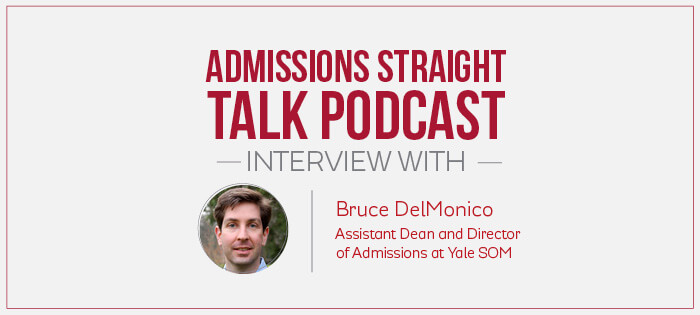
2011 Yale SOM MBA Admissions Q&A with Bruce DelMonico
Audio for Q&A (Click to listen now, or right click and choose “Save As” to download and listen later.)
To automatically receive notices about these MBA admissions chats and other MBA admissions events, please subscribe to our MBA event list.
Linda Abraham: Hello. My name is Linda Abraham. I am the founder of Accepted.com and the moderator of today's chat. First I want to welcome all applicants to the Q&A today, and I want to congratulate you for taking the time to learn more about Yale's School of Management.
It is critical to your decision making process and your admission chances that you know as much as you can about the schools you are applying to. Being here today allows you to ask experts about this top business school. I also want to give a very special welcome to Bruce DelMonico, Director of Admissions at Yale SOM. He is a very busy man and we appreciate the time he is taking to answer our questions. Thanks to everyone for joining.
Bruce DelMonico: Thanks Linda. I'm happy to be here and happy to talk to the candidates who are on the chat today.
Linda Abraham: Great. I would like to take advantage of my position as moderator and ask the first question. Bruce, what's new at Yale's School of Management?
Bruce DelMonico: There is actually a lot that's new at Yale School of Management. The two things that I would highlight though are that we have a new dean coming on board, and a new building is being built.
The new dean, as people probably know, is Ted Snyder, who was most recently dean at Chicago Booth. He is taking a one year sabbatical and will be joining us on July 1, 2011, a little less than a year from now. He has actually been engaged with the school already. He was on campus just a couple of weeks ago to meet with faculty and those visiting staff, and he has actually been doing some prep work to get up to speed so that he'll be ready to hit the ground running when he starts in July.
Then in terms of the new building, I parked next door to it and it's about half a block away from our current campus. We see new developments every day in terms of excavation and construction there. They're building the foundations now and the plan is for it to be ready for occupancy in the fall of 2013. We are very excited about that, yet we love our "mansions" as we call them. We currently reside on a campus of a handful of beautiful Victorian mansions here in New Haven.
Linda Abraham: Do you anticipate any changes with Dean Snyder coming on board?
Bruce DelMonico: I think there will be a few changes, but I don't think anything major. He spoke to the school. We had a town hall meeting in the spring when his appointment was announced, and he's been having a series of ongoing discussions with the school. The question I get asked most frequently is how this will affect the curriculum, because one of the hallmarks of the school is our new integrated curriculum that is now four years old. Snyder has made it very clear that he has no intention of tinkering with that, and he wants to let the faculty continue to develop that as they see fit. We already have some great connections with other schools here at Yale, but the one thing that he has highlighted for us is that he really wants to strengthen those connections even further. He wants to continue to think about ways to develop those connections further; connected to the Law School, the Med School, our Forestry School, and others. He wants us to really try to leverage the advantages that Yale as a university has, and the resources that the university as a whole provides to us.
Linda Abraham: If I recall correctly, in the second year, students can take many classes outside of the Business School. Is that correct? I believe that is one of the distinguishing features at Yale.
Bruce DelMonico: That is right. Students can start to take electives in the spring of their first year. So they can take two or three electives in the spring of the first year, but then the entire second year is completely composed of electives. You are correct Linda; those electives can be taken at Yale SOM, but also elsewhere at the university. Invariably, I don't think I know of a single student that hasn't taken advantage of that opportunity to take classes at the Law School, Forestry School, International Relations, Drama, Architecture, etc. Even the undergraduate classes are open to students. Frequently, they use those to take language classes, but also some other classes that they find interesting to them. I think that is a great way to leverage the rest of the university, and also to really tailor one's education to suit their particular interests. The one example I often give when I talk about this is for example, if you want to go into real estate development or real estate finance, you can take classes here at SOM, you can take real estate classes at the Law School, and you can take sustainable development classes at the Forestry School. You can take architecture classes at our Architecture School. So the whole university is really open to our students.
Linda Abraham: Let's turn to a couple of the applicants' questions. Weigh asks, "I read the blog that about half the invites for interviews have been given out. When will the other half be given out, and will it be in a batch?"
Bruce DelMonico: That is correct. Our e-newsletter went out earlier this week, and actually I've been remiss in my personal blogging, but I do plan to blog about that shortly. About half of our invitations have gone out by now, and the rest will go out between now and mid-December, which is when our decision notification deadline is. Obviously we want to get those out as soon as possible, and not wait till the end of the round. They won't go out in batch fashion; they will primarily go out individually or in smaller batches. I think that most of the activity will be happening between now and a little after Thanksgiving in the States, so that is early December. But we are trying to go through applications as quickly as possible so that we can get those invitations out as soon as we can.
Linda Abraham: Does the timing of an invitation signify anything?
Bruce DelMonico: That is typically asked. The answer is that it doesn't signify anything. We review applications in random order as they become complete, and as they are available to read. We will review them and then as we review them, we send out the invitations for interviews. So when you are invited is not indicative of the posture of your candidacy in the sense of how strong it is, or how strong we think it is. It is really more a factor of when we are able to get to it in a round. So please don't read into the timing of your interview invitation.
Linda Abraham: Karou asks, "Bruce, can you please talk about a students' run initiative that you've heard about over the years that embodies Yale SOM's diversity, and mission to educate leaders for business and society."
Bruce DelMonico: That is a good question. There are a few things that I could think of that would embody the mission of the school and the ways in which the students embody that. Here is one example I will give. As some of you may know, in our first year we have an international experience trip that is mandatory for first year students. It happens during the spring break in March, and it's a ten day trip that all students take to a series of countries around the world. The idea is to get some exposure to different cultural contexts in which business is operated so that our students can be sensitive to those cultural differences. And this was part of our new curriculum that was rolled out four years ago. When the trips were announced, they were great and everybody was excited about them, but the first class decided that they were going to leave a huge carbon footprint because our entire class was going to be flying around the world, and going to all sorts of different destinations. So the first year class developed part of an offset program that would offset part of the carbon impact of these trips. And every year since then, that has been part of the first year trips. Students will buy carbon offsets to compensate for these trips. The students took the lead on this and the school has followed suit and actually helps match the students' contributions. So I think that is one way in which our students help embody the mission of the school of educating leaders for business and society.
Linda Abraham: That is a great example. Rochna asks, "You said that interview invitations will be sent until mid-December, but some applicants need some time to book the flight tickets and arrange for travel. So will applicants who are further away from New Haven be informed about interviews first?"
Bruce DelMonico: That is not necessarily the case. Again we do review files in random order. But that is a reason why we try to get invitations out as soon as possible because we know that it does take time to make travel plans and book tickets. And obviously the more time you have to book, the better your planning will be and the more favorable your pricing will be, so we do try to get those out as soon as possible. And when I say that we can invite people up until mid-December which is when our decision deadline is, it's really only a very small handful of people who are invited at that point. We really try to get the decisions out before then, and for those people, we obviously give them extra time to schedule an interview and make their plans. We know that it's not as though you can get the invitation, jump on a plane, and head to New Haven. We know that there is some planning and some prep work that goes into that. So we will be accommodating on that front. We also want to be mindful of the fact that anyone who has applied in our round one is expecting to get a decision before the holidays, and we want to honor that. We know that goes into an applicant's planning as well; they want to get a decision some time in December, so that is another reason why we try to get our interview invitations out as soon as possible. So those invites that go out near the end are usually just a very small handful.
Linda Abraham: Yardenka's question actually relates to your previous answer so I'm going to ask it now. "Thank you for your time Bruce. Will you reveal decisions on a rolling basis this year, or on the decision notification date?"
Bruce DelMonico: For round one, it will be a single release; it will be right around that decision deadline date. For round two, we tend to be a little more fluid there, and we play it by ear because the time frame is a little bit longer, and the round tends to be larger. So we often will break that up into a couple of release points. We don't have any set release points for round two; it depends on when we feel that we are comfortable with a sufficiently critical mass of applications that we can release them before the deadline. So it's usually two or three release points leading up to that deadline. But for round one, it will just be the one release in mid-December.
Linda Abraham: Reuben asks, "Yale SOM is a member of the Consortium. Regarding dual degrees with Yale SOM such as MBA/JD, can the Consortium fellowship be used to cover the Business School portion of the JD/MBA?"
Bruce DelMonico: Great question. I'll take the first part first, and then I'll talk about the dual degrees. We are now in our third year of being part of the Consortium, and it's been a great relationship for us. For those of you who don't know, the Consortium for Graduate Study and Management is an organization that is committed to promoting diversity and inclusion in American business. It has grown and now it's up to 15 schools. It had been static for a number of years, and then we were the first to join three years ago. Since then Cornell has joined, and now Berkeley and UCLA, and they are looking to add a few more schools in the future as well. And so our involvement really was motivated by the fact that we are committed to diversity of all sorts here on campus. And I think that would echo one of the previous responses about the student run initiative and the international experience that I gave. We really are looking for ways to promote diversity. We have a number of initiatives that are happening here on campus. Earlier this week, we convened our Diversity Task Force Alliance which is chaired by the Dean and consists of students, staff, and faculty who talk about our various diversity initiatives. The Consortium is just one of the arrows in that quiver of diversity initiatives, and we are very pleased to be part of the Consortium. For those of you who don't know, one of the benefits of the Consortium is that there is a common application, so you can pay a single fee to apply to up to six respective schools. And then there are Consortium fellowships that are associated with some number of candidates who are admitted through the Consortium process.
In terms of the dual degree question, the Consortium fellowship can be applied to the MBA portion of a dual degree. It would be pro-rated because if for example you do JD/MBA, you would be in the MBA program for a semester, or if you were doing our three year JD/MBA, it would be a year shorter than if you did the two programs separately. So the fellowship would be pro-rated for your time on campus, but you would be able to apply that fellowship for the MBA portion of your education.
Linda Abraham: Mackley asks, "Do you prefer that dual degree applicants apply specifically to SOM, or should applicants address their desire to pursue a dual degree in relation to their desire to pursue an MBA at SOM?"
Bruce DelMonico: In the application, we do have a section where we ask whether you are applying for a dual degree. So if you apply for a dual degree here at Yale, and we have degrees with basically all the professional schools, you would apply to each program separately. So you are going to be filling out two applications, and the decisions are made independently by each school. For our application, we do ask you to identify that you are a dual degree candidate, and I would think that as part of your application, you will naturally talk about that goal of obtaining a dual degree because it would factor into your essays and other parts of your application when you talk about your career interests and your reason for coming to Yale-SOM, and what you want to do post-MBA. I think that would inherently be part of what you would be discussing. So I would recommend that you do incorporate that into your application because it is an important part of why you are looking to pursue your degree, not just at SOM, but at Yale more generally.
Linda Abraham: Here is another question from Sarab. He asks, "Can you please tell what qualities Yale looks for in a college senior applying for the Silver Student program? What kind of internship and extra-curricular activities play a major role?"
Bruce DelMonico: That's a good question. Just to flesh that out a little bit, Sarab is obviously a college senior applying to this special program at Yale called our Silver Scholars Program. We've had it for close to ten years now. It was initiated during the silver anniversary of the school, the twenty-fifth anniversary of the school, which is why it's called the Silver Scholars Program. It's for college seniors who are applying directly from their undergraduate to come straight through and do their first year of our MBA program here at SOM. Then they go off and do a one year internship, and then come back for the third year to do their second academic year here at SOM. So it's a three year total program, including that one year full-time internship.
Linda Abraham: Is that only for Yale seniors, or is it for all college seniors?
Bruce DelMonico: It used to be only for Yale seniors, but a few years ago we broadened it to include all seniors anywhere around the world. And every year we do have a number of Yale seniors who come straight through to our program. But we also have students from elsewhere in the US, and also elsewhere internationally who are part of this program. And in terms of what we are looking for through this program, because the applicants don't have full-time work experience, other components of their candidacy, for example their grades and test scores tend to be correspondingly stronger.
But I think the question Sarab has was specifically about internships and extra-curricular. Our candidates obviously don't have full-time post-graduate work experience, so we do look at the internships that they've had and the extra-curriculars they have engaged in to gauge the strength of their candidacy. And it's for this purpose. Our program, as all other MBA programs, is looking to bring in and train future leaders. And work experience is one way to gauge someone's ability to navigate the workplace, to motivate others, and to take leadership roles. To the extent that Silver Scholar candidates have been able to have internships and extra-curriculars that give us that sense, that is very valuable to us. Obviously internships is more about a proxy for full-time work experience, to the extent that you've been able to secure internships and you've been able to show that you can navigate the workplace well. You are probably not in a position to have any leadership experience in an internship. It's really more in the extra-curricular, where hopefully in your school you've been able to take on some type of a prominent role within an organization, and have had some sort of leadership responsibilities there. And we look for that as a proxy for what people are hopefully able to do after they graduate, and also for how they will interact on campus. We have students who are very engaged and very involved in campus activities so we do look to make sure that we are bringing in students who will plug into the community well.
Linda Abraham: Great. When you are evaluating applications, and the numbers are in the ballpark and the candidate is basically admissible, what moves one file into the "admit" pile and one into the "rejected" or "wait-listed" piles?
Bruce DelMonico: So basically the question is if candidates are otherwise qualified, what will tip people in one direction verses the other? That is a very difficult question to answer because the process is so multi-faceted. Just to run through, there are a number of different data points that we are looking at. We look at undergraduate records, work experience, test scores, essays, recommendations, and interview activities. And there is no formula or algorithm that says if this is here, then that needs to be there; these are the levels they need to be at. It is more holistic. So it's tough to say in the abstract that one particular thing will tip someone or put someone over the top if they are otherwise qualified. With that caveat, I would again echo my previous response. We are looking to bring in students who we feel have the greatest potential to have an impact here on campus, and to also be future leaders in whatever context or whatever field they plan to go into. So to the extent that we feel we have a candidate, who through the various data points, looks as though they are better positioned or better poised and seem like they have the skills to achieve those leadership goals, those are the ones that we are more likely to bring in.
Linda Abraham: Rochna asks, "I have read my application more than ten times, but I'm sure there will be a couple of typos that I missed, or some commas or something like that. How much do these kinds of writing errors hurt the chances of admission?"
Bruce DelMonico: I guess my first answer is if you have read it that many times, you should hopefully be eliminating all your typos. So hopefully there aren't any there. That said, I guess I would start by saying that not all typos are created equally. Some real estate is more valuable than other real estate on an application. So if you are making a typo in your resume which is supposed to be very tight, highly formatted, and a very concentrated summary of your profile, that is somewhere where a typo will stick out much more than if it's in a long essay which is something that maybe we'll be a little more forgiving of. As another example, we've actually had people who have misspelled their names in their application; they've had a typo in their name! That just shows extreme sloppiness and that's pretty high profile real estate right there. In that sense, it's not just that there is a typo but it's where the typo is, and the kind of typo. This isn't English class and it isn't a grammar class so we are not going to be hypersensitive about punctuation as long as it seems to make sense. That is not really the dimension along which we are trying to sort candidates. It's more what the typos indicate in terms of someone's diligence and attention to detail. That is more what we care about. And the sort of typos that suggest sloppiness and lack of attention to detail are really what we care about more. A couple of commas here and there are not really what we care about in essays. But misspelling your name, or having major typos on your resume which is supposed to be very strictly formatted, is another thing.
Linda Abraham: I might add just from what we see that some typos lead to some absolutely hysterical outcomes. And while the humor may be appreciated, it does not necessarily reflect well on you. So those are also typos that while they may not doom your admission chances, they may not exactly be what you want to be known for or the impression you want to be making. If you want to proof your essays one more time, one method that I have found very effective for proofreading my own writing is to print out the document, move to a different location (don't sit at a desk where you always sit), and read it slowly, out loud. And by reading it slowly, out loud, as it reads, you will catch things; you might catch the missing comma, you probably will catch the silly typo. It's a very good way of proofing your writing.
Bruce DelMonico: Just to piggyback on that, one other piece of advice that I give, and it's very time consuming, is to read backwards. So start at the end of the essay and read backwards. It's not a great way to catch typos in terms of the commas and punctuation because you won't be reading the sentence structure, but it will force you to read each word individually. A lot of times when you read forward, you just assume you know what that word is and you just skip over it; you're not really looking at it.
Linda Abraham: That's one of the reasons it's worth reading out loud. And the other problem with reading backwards is that you won't catch homonyms that are wrong; words that are spelled differently, but sound the same. The spelling is a correct word; it's just the incorrect word for that location.
Bruce DelMonico: Right, that's a good point. Spell Check is often not applicants' friends, when it comes to those words.
Linda Abraham: It's certainly not the final friend, let's put it that way.
Let's get back to some other questions. Caral asks, "Bruce, I've read that you were an attorney before joining Yale SOM. Do you have any advice for career changers and what resources can Yale offer career changers?"
Bruce DelMonico: Sure. That is an excellent question. I was an attorney before Yale SOM, and I was a litigator for a number of years. Just as an aside, I think that going from litigations to admissions is a great transition, actually a more sensible one than you would think, because as a litigator you are trained to take disparate sets of facts and try to make sense of them. It's really a lot about synthesizing information, and that is a lot of what admissions is as well.
In terms of career changers, programs such as ours, and other full-time MBA programs do get a fair share of people who are looking to make a career pivot or change their careers. And they are good in the sense that the full summer internship does provide an opportunity to try out a new career. And two years really does give the chance to take the time to learn more about the various industries, and to learn more about the companies and the various players that you are interested in, and really execute a career search that works for you. So we do get our fair share of career changers.
I would also say as an aside that we often find that people will change their career goals even after they've started the program. I think I've seen a statistic that has said that up to 70% of MBA students end up doing something different than what they came into the program thinking they were going to do. And I think that is a testament to the fact that there are so many opportunities open for students; they learn about so many different types of things that they didn't even realize were possibilities before they started the program, and they are drawn in a different direction than they thought they were going to go. That is not to say that it happens to everybody, but there is a significant portion for which that is the case.
So here is my advice to career changers, and this strategy is true both in terms of how you want to position yourself from an admissions perspective and also from a program addict perspective, for once you are in a program. It's very helpful. You really need to know what you think you want to do after you graduate, even if it ends up being something different than what you actually do end up doing. It's not as though at graduation we take out your essays and don't give you your diploma if you don't do what you said you were going to do. But so much happens so quickly in these programs. Even from the start of Orientation, our Career Development Office will be working with you on skills assessment, inventories, getting to know the various industries, and doing resume writing and mock interviews. So much happens so fast on the career development front as well as the academic front and otherwise, that there is not really time to figure it out on a fly. It's fine if you changed what you want to do and you changed your mind even after you started the program, but you really need to go in with a thought or a plan or an understanding of where you think you want to go with your career.
And then in terms of resources for a career change, we have a full service Career Development Office that works with students from the very start of Orientation to educate them about the various opportunities that exist out there; all three sectors, the various industries within those sectors, and the various players within those industries in terms of firms and organizations. And then they work with our students on a one-on-one basis to devise the search strategy that will help them land the job that they are looking for. We are used to seeing career changers in the program so that is not anything that is unusual in terms of a profile for our Career Development Office or for the rest of us here at the School of Management.
One thing I would note is that we often have graduates who will change careers. Because we have a very broad mission and a multi-sector approach, we have students and then graduates who have very broad interests and they want to do various things. They are kind of intellectually restless, and have a very large checklist that they want to get done career wise before they retire. So we often have graduates who start in the private sector and then will move into the public sector and then move into non-profit, and then back to the private sector. They tend to move around in these interesting trajectories. And our Career Development Office actually offers its services to all of our graduates. So it's not just for the students who are there on campus, but throughout your career, the Career Development Office is available to you as you are moving around and navigating.
Linda Abraham: So alumni can come back and contact SOM and get career advising even as alumni?
Bruce DelMonico: They can. We used to have a dedicated resource that was focused on alumni counseling and alumni guidance, and now they've actually restructured it. Our Career Development Office is structured according to Relationship Managers who have an expertise in a specific industry or set of industries. All of our Relationship Managers are now open to all of our alumni, so they work both with students and with alumni.
Linda Abraham: Ritcha asks, "Are there any specific criteria that Yale SOM looks at while reviewing an application from a career changer?" And Bruce, while you are thinking about how to answer that question, I want to ask the applicants how many of you are applying to the MBA program with the intention of changing careers? Okay. We have 48%, which would be right in line.
Bruce DelMonico: Obviously given the number of people who want to change careers through an MBA program, that is obviously a very important and relevant question. I would answer it on two different levels. The first is substantively in terms of the substance of what you want to do. We tend to be pretty agnostic; we are not valuing one type of career over another. So say you are in finance now and you want to go into marketing, or you're in the public sector now and you want to get into finance, or you're in the non-profit and you want to do healthcare, we are not making a judgment about which of those changes are better or worse. So we are indifferent and agnostic on that level. What we are looking for is to get a sense of how deeply held that switch is; how well thought out is, how much that switch is supported by evidence of commitment to that switch.
Linda Abraham: In other words, if somebody says that they want to save the whales but they've never been to the beach, that's a problem.
Bruce DelMonico: Exactly. And because we have a reputation for being strong in the non-profit sector, we have a number of candidates every year who will throw in there that they want to go into non-profit. They're not doing that right now, and they've got no evidence or indication anywhere that they've volunteered or have done anything to show an interest in this area. So it's that exactly; save the whales, but I've never been to the beach. I like that example.
One thing that goes along with that is that we are not judging the switch you want to make or what you want to go into, but we also want to get a sense that it is somewhat realistic, that you have a sense of what it takes to make that switch. I'll give another example. Private equity has been very popular and every year we do have a number of students who go directly into private equity, but it's very difficult to do if you are not coming from finance or you don't have some background. And every year we get candidates who are doing something completely unrelated. They may have done good work, and it may be very interesting work, and it may be very valuable work, but they say that directly after the MBA program they want to go into private equity. Well, you need to have a better sense of what the trajectory of someone is to get into private equity, and what the steps you need are to make that switch. It's not something you can just jump right into; there is a lot of work that goes into it. And so you need to have a sense of the steps that it takes; that you may need to get some more general experience in diversified financials, and then maybe do some investment banking, and then work your way into PE. That would show that you are a much more serious candidate, and you are being much more thoughtful about the process rather than just saying I'm going to go from retail to private equity and there is nothing in-between those two.
Linda Abraham: That makes a lot of sense. Bater asks, "Would an applicant be at a disadvantage if he chooses to write essays only about his professional life, rather than dedicating one or more essays to his extra-curricular work?"
Bruce DelMonico: I don't think so. I'm very much speaking in the abstract, and it's not a one size fits all piece of advice. You need to take these general guides and apply them to your specific situation. But I don't think there is inherently anything wrong with just writing about your professional experience or your professional background. I think it just depends on what you choose to write about. We do allow candidates to choose from a long list of essay topics. Depending upon what you choose to write about, it's very possible to write just about your professional experience, and I think that is perfectly fine. There are other ways to interject your extra-curriculars; through your resume, and if you're invited to interview. And if you want to write about extra-curriculars in the essays, that is obviously, open to you as well. But there is nothing that would disadvantage you if you only write about your professional life.
Linda Abraham: Great. Amir asks, "Is there any preference for GMAT over GRE? Also how does Yale view an applicant with limited full-time work experience due to being enrolled in graduate school, in this case law school since undergrad?"
Bruce DelMonico: So it's really two questions, and I'll take the GMAT/GRE one first. I'll say very simply that we don't have a preference for one over the other. We allow candidates to take either one and submit either one, and that indicates that we value both. We are not going to mark someone down for submitting one over the other. Interestingly, we accepted GRE scores last year, and actually our admit rate for GRE test takers was the same as for GMAT test takers which was a nice, objective, independent validation that we were not valuing one over the other. It was clear that we were not showing any bias of one over the other by the fact that the admit rate was the same.
In terms of how Yale views applicants with limited work experience due to being in a graduate program, this is sort of a suit of a Silver Scholar though not really because you haven't been getting other experience through your post-grad education. I think it really depends on the individual profile. Again, this is not a one size fits all piece of advice. I can't say that we look at a candidate with this profile this way, and with that profile that way because it's all very contingent; it's all very application specific and very pool specific. The general guideline that I would give that applies to an applicant coming directly from another graduate program or even to anyone applying generally, is that one thing we want to get a sense of from your application is why you feel that it is the right time for you to get an MBA now. And everybody has a different jumping off point; everybody has a different reason. For some people it's because they want to get their MBA early in their career based on what they've done in the past, and where they are in their career. For other people, they have been in the workforce for a little bit longer, and have been continuing to learn and grow and get benefits from that, and then they hit a point where they decided the MBA is right for them at that point. So whether you are coming directly from another graduate program, or you've been in the workforce for ten years, the question of "Why now?" is really the key one. And that is for sure the test you should use to determine whether now is the right time to apply. And also if now is the right time to apply, use the "Why now?" question to guide you to craft your application to help us understand why you are applying to us now; why you are going directly from law school to business school, or why you waited 7 or 10 years, or however long it is, to apply to a full-time program.
Linda Abraham: Tom asks, "Can you please share the financial aid options, specifically for international students?" Now, I assume that this is one of those things that there is lots and lots of information on, so maybe just give us a very high view of it and a place where Tom and others can get more information.
Bruce DelMonico: Sure, that sounds good. I am not the director of financial aid; we have a separate financial aid office. One thing I will say for international students specifically is that I know there has been a lot of instability in terms of financial aid options for international students over the last few years. I think that things have somewhat stabilized although I obviously am not fully up on where other schools are. We have been fortunately rather insulated on that because we fund our own international student financial aid program; it's a Yale funded program, and so it hasn't been subject to the winds and follies of outside lenders. And so as part of that, international students can borrow up to the full amount of tuition and mandatory fees. This is available to them without a cosigner, and it is under favorable terms in terms of interest rate, and in terms of differing interest, and payments not being due until six months after graduation. So it has very fair ruled terms, and that is something that we have made available to our students uninterrupted over the last several years which has been nice.
We obviously also do have a full range of financial aid options for domestic students as well. Most students take out loans and we have an office that helps support them in terms of that loan process. We also do have some merit scholarships that are available to students. All candidates who apply to the school are automatically considered for merit scholarship, and we do notify candidates at the time of admission whether they have been awarded one. But that is something that is less universally available; it's the minority of students who end up getting merit scholarships. But the international financial aid program is available to all foreign national students.
Linda Abraham: Great. Manita asks, "What is Yale SOM's current record and future outlook on job opportunities for international students? What additional measures is Career Services taking to help international students in the current US market?" So it's internationals looking for jobs abroad, and internationals looking for jobs in the US.
Bruce DelMonico: That is obviously a very important question because you all are coming to an MBA program with the idea of having a full and satisfying career after graduating. In terms of job opportunities for international students, both domestically and internationally, our Career Development Office works with all students on an individual basis to craft their career search. In terms of jobs overseas both for international students and domestic students, that has actually been a strong and growing area. I think a lot of the opportunities, especially in this economic downturn, have been international ones. So Europe and Asia, Asia in particular, has been quite strong. And we tend to post a lot of students in London, Hong Kong, and other areas where there are good job opportunities. And that is for both international students and US students.
In terms of jobs here in the US, we have good relationships with all the top employers, and we have a full on-campus interview process. And for those companies who aren't coming out to campus, we have good relationships with them and can work with the students to develop a more targeted search process. I think that the opportunities have been good. I know that Business Week did a survey last year of all the top business schools for the class that graduated in 2009, and we came out #1 in terms of job placement at 92% three months after graduation. And this year our job placement rate was on par with last year. I don't know yet where that stats up against other schools, but that certainly is probably of the highest. So we certainly have been very successful in placing students generally. And international students have actually fared quite well abroad and in the domestic US market.
Linda Abraham: Okay, great. Jason asks, "Does one need to have entrepreneurial experience to join the SOM Entrepreneurship Program?" And can you tell us a little bit about opportunities at Yale SOM for people interested in entrepreneurship?
Bruce DelMonico: Entrepreneurship is an area of what seems like growing interest among business school candidates. You do not need to have specific entrepreneurial experience beforehand to be involved in entrepreneurship at SOM. So it's not as though there is that type of prerequisite. In terms of what type of opportunities there are here at SOM, it's full range. Obviously we have an Entrepreneur Club which has a host of activities that they undertake. There are obviously courses that you can take part in; there's a Business Planning class that David Cromwell runs, there is a Legal Aspects of Entrepreneurship class. So there are a whole host of classes related to entrepreneurship.
But I think the question speaks more to extra-curricular activities. One of the nice things about being at SOM is that you can plug into the larger community. And actually here at Yale, we have two organizations: the Yale Entrepreneurial Institute (YEI), and the Yale Entrepreneurship Society (YES). Both of those are university wide organizations so it's not just SOM students, but it's also undergrad students from engineering, law school, medical school, and elsewhere. Those are organizations that help us support students in their entrepreneurial activities. There is the Y50K business plan competition that has a $50,000 prize associated with it. There are other activities throughout the year in terms of working with fellow students around the university on business plans, and having speakers come in. I think there are other informal channels even here at SOM to get counsel and advice from faculty members and from fellow classmates. Sometimes even occasionally there is even some seed money available, depending upon who you can connect up with here in the community. So I think that there is a lot going on in terms of entrepreneurial activity. Just to echo again, there is no prerequisite for that kind of experience beforehand in order to be a part of this.
Linda Abraham: How do you see application volume this year at SOM compared to last year? And do you have any last tips for round two and round three applicants, who are yet to hit "Submit"?
Bruce DelMonico: Sure. Obviously as you know, we've only been through one round, so the majority of the season has yet to come. Obviously we don't know what the ultimate numbers will be. Right now we look to be right up to par with last year in terms of volume which is nice because I've seen articles and numbers saying that things might soften a bit. And I know that GMAT test taking looks like it's down a little bit. But we're holding firm over last year so I think that is nice.
In terms of final tips for those who have yet to hit the "Submit" button, I actually have an "Application Tips" chat coming up in November. I believe it's November 10th or 11th. I have a one hour long session where I go through various pieces of advice about the application for people who are still in the process of applying.
Linda Abraham: What's your number one top tip?
Bruce DelMonico: So that was a prelude to say that I can go into more detail elsewhere, but my bottom line top tip is to pay attention to your essays, but don't stress about your essays. You want to answer the question concisely, cleanly, and simply; don't go overboard with it. And I think that is the best piece of advice I can give. And then hand in hand with that is to be yourself. And I know other admissions offices say this, and I know it's a piece of advice that you hear a lot, but it's not just a platitude; I think it's really important. And it's not just a matter of us getting to know the true you, but it's also just from a strategy standpoint. The best way to stand out is to not sound like everybody else. And a lot of times people tell us what they think we want to hear, and if everyone does that, it makes everyone sound the same. But if you tell us what you genuinely believe and think, that is the best way to stand out. So it sounds very simplistic and it sounds a bit like a platitude, but I think that is both the right thing to do and also a good strategy.
Linda Abraham: I couldn't agree more. I've had many friends' children or friends of my children who have come to me and asked me to review an essay. These are people I know very well, and I read the essay and I said, "I don't see you in this essay". I just don't meet them; I don't see them at all. I don't see any of their personality; I don't see any of their energy, any of their charm, or anything of them in there. It's like they are almost hiding themselves.
Bruce DelMonico: One other aspect of that is that people often think of how they present themselves, looking especially at the essays and what they say about themselves. But you have to realize that we as the Admissions Committee are looking at your entire profile. So it is going to include things that you say about yourself, but also things like the recommendations where other people are saying things about you. And if you are saying things about yourself that are inconsistent or different than what your recommenders are saying about you then that raises a red flag to us. Again to put on my lawyer hat, when we prepare a witness for their position in trial, we tell them to tell the truth. That's probably because it's the right thing to do, but also because it's the easiest thing to remember, and it's the thing that is most consistent. Not to that level, but it's the same kind of concept; what you are saying about yourself needs to be in line with what other people are saying about you. And if it's not, and you've shaved things one way or the other then it can raise a red flag.
Linda Abraham: Thank you all again for participating today. Special thanks to Bruce for joining us today.
If you have additional questions for Bruce, please email them to mba.admissions@yale.edu.
We look forward to seeing you at future Q&A and Events. We have several upcoming Q&As, including Visit
our event schedule page for our full list of upcoming events and details, or to register. You can also
subscribe to our events list by clicking reminders on our event schedule page.
Good luck with your applications!
MBA Q&A Index ||
Upcoming Q&A/Events ||
Yale SOM B-School Zone
Sign-up for an Accepted.com free MBA admissions email course:
|  |

Security Tested Daily
|
 |
The Highest Rating
|

Sachin will turn your coal of an essay into a diamond. Rest assured: the money you spend will be paid back to you many times over your career."

»May O&E - 2013 Admissions Season Begins
- Pieces of the Puzzle
|
|